Inferno: The Long-Awaited Descent into Sonic Mysticism—13 Years…
There are some waits that become legendary even before they end. The anticipation for a new Boards of Canada album had long entered that territory. Inferno is the Scottish duo’s fifth studio album and their first in thirteen years, since Tomorrow’s Harvest (2013), which many had already considered their final testament.
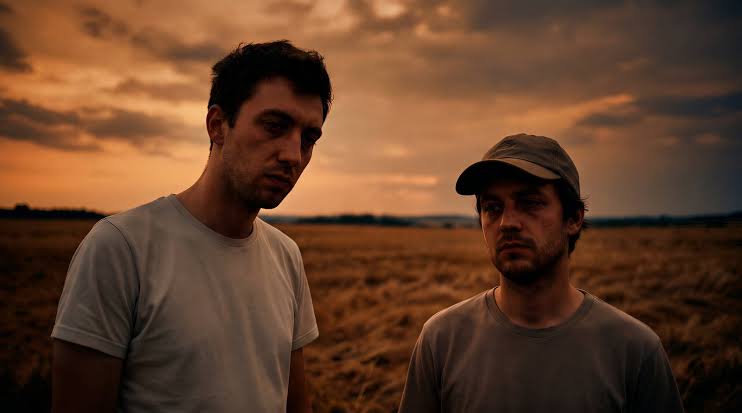
The magic brothers.
Michael Sandison and Marcus Eoin have returned, and they’ve done so with the darkest, densest, and most direct work of their entire career: 69 minutes designed to be listened to as one uninterrupted flow rather than a collection of individual tracks.
Hauntology.
To understand where Inferno arrives, it’s worth remembering where Boards of Canada came from. Their very name is taken from the National Film Board of Canada documentaries — those warm, slightly faded educational films from the 1970s that shaped an entire generation. That aesthetic of worn-out film stock and analog tape has become their signature: a nostalgic yet unsettling sound that many later labeled as hauntology — the feeling of remembering something that perhaps never truly existed.
The origins.
Raised in a musical family and active since the early 1980s, the Sandison brothers emerged in the 1990s on the Warp label alongside Autechre and Aphex Twin. It was Autechre’s Sean Booth who first brought them to Warp’s attention. Their 1998 debut Music Has the Right to Children clearly carried the DNA of intelligent dance music (IDM), yet reducing Boards of Canada to “cerebral electronica” would be a mistake.
The heritage.
Their sound also contains the ambient heritage of Brian Eno, the cosmic breath of German krautrock, the liquid abrasion of My Bloody Valentine’s shoegaze, and — especially on The Campfire Headphase (2005) — heavily treated guitars that become sonic landscapes. Add to this a love for the cryptic: numerology, distorted samples, children’s voices, and esoteric references that turn every album into a puzzle for the initiated.
The mystery.
The duo has always been notoriously private. Their return followed their signature cryptic playbook. In May 2025 fans noticed the reactivation of an old Tomorrow’s Harvest site with mysterious Morse code messages. In April 2026, VHS tapes were mailed to supporters and cryptic posters appeared in several cities. On April 16 they released the first new music in 13 years (“Tape 05”, later renamed Deep Time). The official announcement came on April 22 with a 42-second trailer and their classic hexagonal artwork.
Inferno was produced, as always, by Sandison and Eoin themselves. The main evolution lies in a greater emphasis on live instrumentation and the prominent, almost liturgical use of sampled voices throughout the record.
The liminal abysses.
The title is no coincidence. This is an album of descent, and religious and cosmological references run through the entire tracklist. It opens with the 36-second Introit, echoing both Catholic mass and the spirit of their classic “Happy Cycling.” From there it plunges into Prophecy at 1420 MHz — a direct reference to the hydrogen line frequency used in radio astronomy and SETI.
Highlight.
Tracks like Hydrogen Helium Lithium Leviathan, Age of Capricorn, and Father and Son weave together themes of creation, faith, and filiation. Not everything is darkness, though. Into the Magic Land brings back shimmering shoegaze guitars, while Deep Time offers some of the album’s most delicate moments. The closer I Saw Through Platonia fades into the simplest and most disarming sound possible: a human heartbeat.
Inferno may feel challenging at first for those who fell in love with the pastoral warmth of their early work. This is a more mature, uneasy, and adult record — a meditation on deep time, faith, and the things we believe without being able to touch. And yet, beneath the ashes, light still filters through. In its quieter moments, it contains some of the most beautiful and moving music the duo has ever created.
For those who prefer music to be inhabited rather than merely consumed, Inferno is an album that will reward years of listening. Boards of Canada didn’t disappear. They simply went deeper — and came back with the map.
By Massimo Garofalo.
──
Maybe you might find this post interesting too. 👇
The Great Disconnection | AI Singularity: Extinction by Omission
Leave a Reply