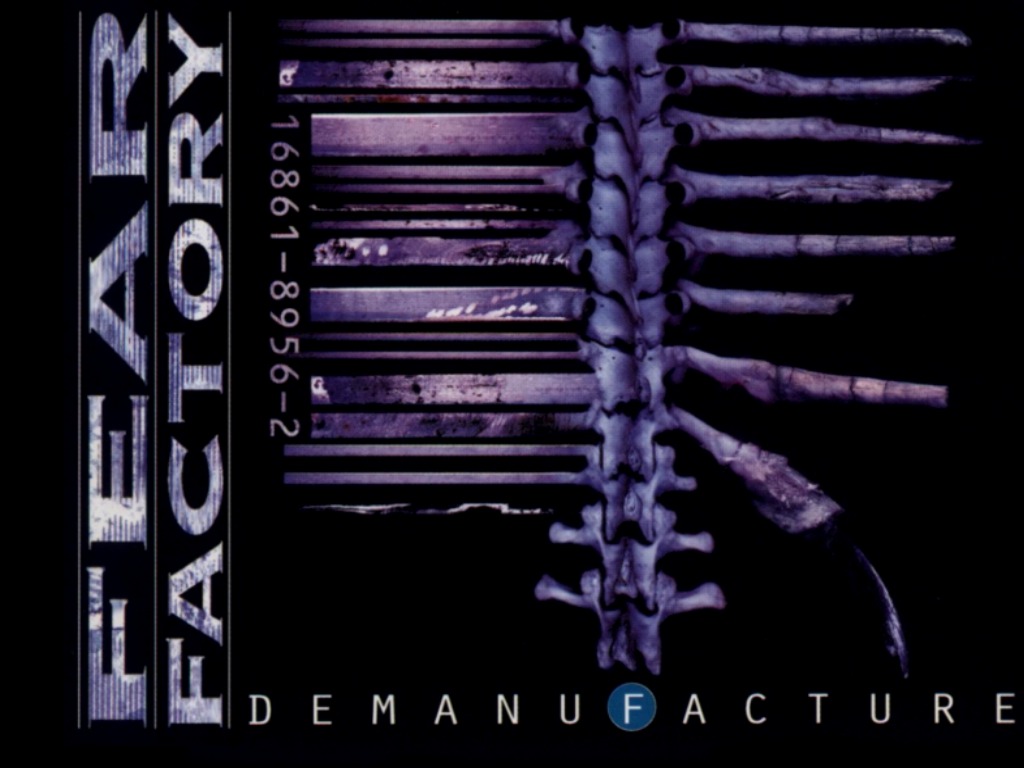
I have always agreed with Fear Factory’s vision regarding the blind technological development in the name of profit that is leading humanity to disaster. This way of seeing things contributes to the dark atmosphere of my novel.
[By Luca Della Casa]
I certainly owe a lot to “Demanufacture”: it’s a tremendously powerful album that was ahead of its time and continues to be considered a masterpiece by those like me who loved industrial metal.
The steamroller Fear Factory’s riffs helped me write the most violent and underground parts of “Arcane-tech”. The incipit, for example, is pure and devastating industrial metal—Fear Factory’s style; immagined and written listening to tracks like “Self bias resistors”.
Although I appreciate the entire production of Fear Factory, “Demanufacture” remains, in my opinion, their best work.
It might be a sentimental issue… We must not forget that at the time, no one was producing anything musically similar. Fear Factory were pioneers in uniting icy melodies, industrial samples, and death metal. The first and the best, always.
Fear Factory formed under the name “Ulceration” in 1989 in Los Angeles, California, thanks to guitarist Dino Cazares and drummer Raymond Herrera.
The name Ulceration was abandoned without a real reason, other than the fact that singer Burton C. Bell and the other band members wanted a new and inspired name for the group. In 1990, the moniker “Fear Factory” was adopted.
The band’s sound was a very original idea for those years. They combined the electronic sounds of industrial with the seminal sound of thrash and death metal, thus giving life to their debut album “Soul of a New Machine” (1992). The album, however, did not achieve a great success. Such a result, however, did not discourage the group: Fear Factory threw themselves headfirst into two tours, one around the United States with Biohazard and Sick of It All, and one across Europe with Brutal Truth.
It is important to note that only “Soul of a New Machine” featured elements typical of death metal because, from subsequent productions, the group made a radical and general diversification of its sound.
The following year, they hired Rhys Fulber (Front Line Assembly) to remix the tracks, giving birth to “Fear Is the Mindkiller” (1993).
In 1994, bassist Andrew Shives was forced to leave the group and, in the same year, the Belgian Christian Olde Wolbers, also a bassist, met the band during a trip to Los Angeles; Wolbers agreed to help Fear Factory in the realization of their next work “Demanufacture” (1995), destined to become their greatest success, considered one of the most innovative and characteristic albums in the history of heavy metal.
Here are the “key tracks” from Fear Factory’s “Demanufacture” (1995), widely regarded as the album’s most iconic, influential, and frequently cited songs—both by fans and in the context of industrial metal history:
1. “Demanufacture”
– The title track and mission statement. Crushing riffs, mechanical precision, and a chilling anti-technology manifesto. Often considered the album’s centerpiece.
2. “Replica”
– The breakout single with a haunting, melodic chorus. One of the most accessible yet brutal tracks, blending melody and aggression. A staple in live sets.
3. “Zero Signal”
– Relentless, machine-gun drumming and dystopian lyrics. A fan favorite for its intensity and futuristic sound design.
4. “Self Bias Resistor”
– Explosive energy, sharp electronic pulses, and one of Burton C. Bell’s most aggressive vocal performances. A live powerhouse.
5. “New Breed”
– Cybernetic themes, infectious groove, and a perfect fusion of industrial electronics and metal riffing. Often praised for its forward-thinking production.
These tracks define the album’s legacy: cold, mechanical, prophetic, and sonically revolutionary.
Arcane-tech: Shadows in the Machine, Was inspired by “Demanufacture”, “Replica”, and “Zero Signal”: the purest expressions of that dark, anti-technological vision.
“Replica” hits like a confession whispered inside a steel womb.
From the first chug of Dino Cazares’ down-tuned riff, you’re already inside the factory: conveyor belts humming, sparks flying, a human blueprint sliding toward the stamping press. Then Burton C. Bell sings—clean, almost fragile—“There is no love…”—and the temperature drops below ten degrees. That’s the moment the song stops being metal and becomes prophecy.
The lyrics are brutally simple, almost nursery-rhyme sparse, which only makes them cut deeper. “Desire to duplicate / A flawed design of human life.” It isn’t poetry; it’s a spec sheet.
Humanity, reduced to a defective template that some faceless R&D department keeps reprinting because the margins are good.
The phrase “desperate need to procreate” could describe sex, could describe cloning, could describe the quarterly growth targets of a biotech megacorp. Fear Factory never chooses; they let the ambiguity do the bleeding.
And then the chorus arrives, four identical lines hammered home like rivets:
> I am a replica
> I am a replica
> I am a replica
> I am a replica
Repetition as identity theft. Every cycle erases a little more of whatever soul might have slipped through quality control. The clean vocals ache with something close to tenderness, as if the copy itself is begging the original to acknowledge it. But the original is long gone—probably disassembled for parts.
Musically, the song is a perfect contradiction. Raymond Herrera’s double-kick gallops like a heart in tachycardia, while Rhys Fulber’s icy synth pulses keep the temperature cryogenic. It’s flesh trying to stay warm inside circuitry. Bell flips between melodic pleading and guttural contempt the way a glitch flips between 0 and 1, reminding you that the replica isn’t just made of flesh—it’s trapped in it.
For the underground chapters of “Arcane-tech: shadows in the Machine” I kept coming back to that trapped sensation.
There’s a scene where the protagonist watches a surveillance feed of himself entering a building he has no memory of leaving. I had “Replica” on loop. The chorus became his interior monologue, a litany that starts as horror and ends as resignation. He mouths the words without sound, because speaking them aloud would mean surrendering the last shard of self he’s still clutching.
Fear Factory recorded this in 1995, back when cloning was still sci-fi and the word “replica” mostly meant bootleg Nike sneakers. Thirty years later, we’re arguing about lab-grown meat, deepfake presidents, and whether an AI can hold copyright. The song doesn’t feel prescient anymore; it feels like a status report.
Listen closely at 2:47—there’s a half-second dropout, just the synth heartbeat left alone in the mix. That’s the closest “Replica” ever comes to silence, and it’s devastating. A skipped beat in the assembly line. A glitch that almost sounds like doubt.
Almost.
Leave a Reply